
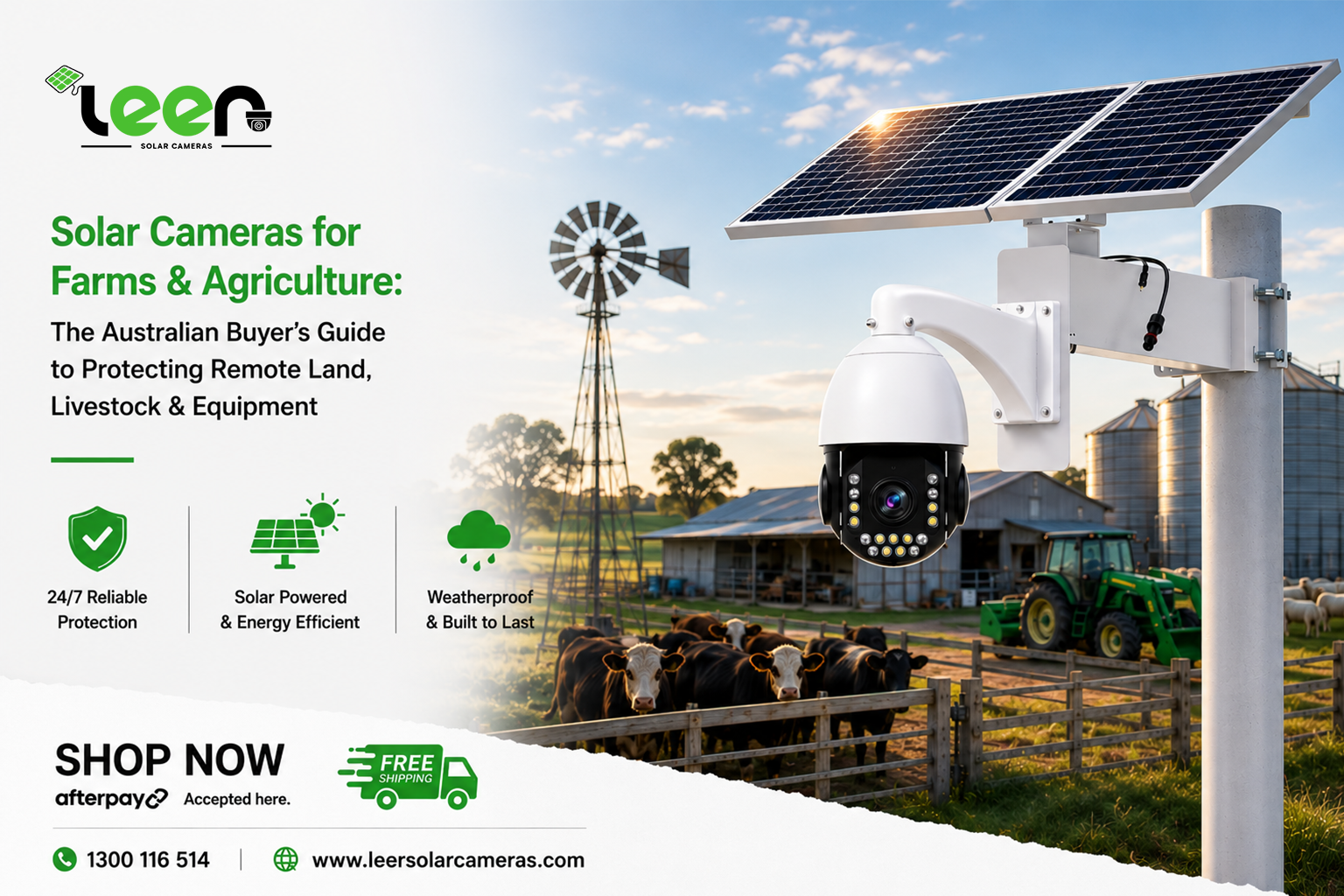
Running a farm or agricultural operation means securing more ground than any other property type in the country, paddocks, sheds, machinery yards, fuel stores, water points and kilometres of fence line, often with no power and no mobile reception in sight. Traditional CCTV was never built for that. Solar-powered, 4G-connected cameras were.
This guide to farm and agriculture security cameras walks through how a solar farm security camera actually works, what a 4g solar security camera for your farm really costs, how they hold up through a cloudy week, and which setup suits which job, so you can protect your land without trenching a cable or paying a power bill.
Key takeaways
-
Solar + 4G cameras run completely off-grid: no mains power, no WiFi, no trenching. Ideal for remote paddocks, gates, sheds and water points.
-
Battery autonomy matters more than panel size. A well-built system holds 2–5 days of charge so it keeps recording through overcast weather.
-
Match the camera to the job. Livestock monitoring, machinery yards, perimeter and number-plate capture each call for different lenses, ranges and features.
-
Rural crime is rising. Farm theft and vehicle offences across Australia hit multi-year highs in 2025. Visible, alerting cameras are one of the cheapest deterrents available.
-
Buying usually beats hiring for permanent infrastructure, and quality solar cameras now start at a few hundred dollars rather than the five-figure systems of a decade ago.
The rural security problem
Isolation is exactly what makes farms attractive to thieves: fewer witnesses, long response times, and high-value targets sitting in the open. And the numbers are heading the wrong way. In the 12 months to September 2025, farm-related crime in Victoria reached its highest level in five years. Livestock worth around $1.51 million was stolen across 170 recorded offences, while theft of goods and vehicles from farms rose to 1,621 offences (Stock & Land, December 2025).
It's not just livestock. The losses that hurt most are often:
-
Machinery and tools: quad bikes, side-by-sides, generators, welders, GPS units off tractors.
-
Fuel: diesel and chemical theft from on-farm tanks, frequently in repeat hits.
-
Livestock: stock loaded out through remote gates, sometimes across state lines.
-
Trespass and illegal hunting: damage to fences, gates and crops.
You can't be everywhere on a 500-hectare property at once. A camera that watches the gate, the shed and the fuel store, and pings your phone the moment something moves, effectively gives you eyes across the whole operation from wherever you happen to be.
Why mains and WiFi cameras fail on farmland
Standard home CCTV assumes two things a farm almost never has at the spot you need watched: a power point and a WiFi signal.
Running mains power to a remote gate or paddock means trenching cable, and that gets expensive fast. Quotes routinely run from $75 to well over $120 per metre once you account for excavation and certified electrical work. Stretch that a few hundred metres to a back gate and you're spending more on the trench than on the cameras.
WiFi has the same range problem in reverse. A home router covers a house; it doesn't reach a shed 400 metres away, let alone the far boundary. By the time you've added repeaters and a power source for each one, you've built an expensive, fragile network for a single camera.
Solar plus 4G sidesteps both. The panel supplies the power; the mobile network supplies the connection. Nothing to trench, nothing to cable, and you can pick the camera up and move it when your needs change.
|
Solar + 4G camera |
Mains-powered WiFi camera |
|
|
Power |
Self-sufficient (panel + battery) |
Needs a power point or trenched cable |
|
Connectivity |
4G mobile network |
Home/router WiFi (short range) |
|
Best for |
Remote gates, paddocks, sheds, water points |
Buildings with power and signal |
|
Install |
Mount and go, no electrician |
Trenching/cabling, often an electrician |
|
Relocatable |
Yes, move it any time |
No, fixed to power source |
|
Ongoing cost |
Small monthly SIM/data plan |
Electricity |
How solar + 4G farm cameras work
There are three parts working together:
The solar panel and battery. The panel converts daylight into power and tops up a built-in lithium battery. The battery, not the panel, is what runs the camera overnight and through bad weather, which is why its capacity is the spec that matters most (more on that below).
The 4G connection. A SIM inside the camera connects to the mobile network, the same way your phone does. That's what lets you watch a live feed and receive alerts from anywhere: the next paddock or the other side of the country.
Smart monitoring. Modern cameras use on-board AI to tell the difference between a person or vehicle and a swaying tree or passing kangaroo. When something relevant triggers it, you get a push notification with a clip, so you're not buried in false alarms.
Put together, you get a camera you can bolt to a post in ten minutes and forget about, no wiring, no router, no maintenance runs.
Will it run through a cloudy week?
This is the question every farmer actually wants answered, and it's the one most buying guides skip. Here's the honest version.
Battery autonomy is the real spec. A quality solar camera built for Australian conditions should hold 2–5 days of recording on a full charge with no sun at all. That buffer is what carries it through an overcast stretch. When you compare cameras, look past the panel wattage and ask how many days the battery lasts in the dark. (For a deeper look at battery and hardware lifespan, see our guide on how long solar-powered security cameras last.) For reference, the ArmorEye 2.0's 20,000mAh battery runs 3–5 days with no sun, while the Horizon's 80W panel and 40Ah battery hold charge for weeks, purpose-built for Australian winters.
Panel size should match the camera's appetite. A simple fixed camera sips power and a small 5–10W panel keeps it topped up. A pan-tilt-zoom (PTZ) camera that swivels, tracks and zooms draws far more, so it needs a bigger panel and a bigger battery. Undersizing the panel is the most common reason a cheap solar camera dies in winter.
Winter and latitude are real, but manageable. Shorter days and lower sun in June–August mean less charge per day. Two things keep you covered: a generously sized battery (the 2–5 day buffer) and smart power management, recording on motion rather than 24/7, and dimming idle features. A properly specced system runs year-round across Australia; an undersized bargain unit is the one that fails in July.
The fix for problem spots. If a camera sits under tree cover or faces south, angle the panel north and tilt it toward the winter sun, or step up to the next panel/battery size. It's a sizing decision, not a dealbreaker.
Rule of thumb: buy for your worst week, not your best. If the system comfortably survives five cloudy winter days, every other day of the year is easy.
What to look for in a farm camera
|
Feature |
What to aim for |
Why it matters on a farm |
|
Resolution |
4MP or higher |
Reads number plates and faces, not just blurry shapes |
|
Range |
Suited to the distance you're watching |
Wide paddocks need zoom/PTZ; a gate needs less |
|
Night vision |
Full-colour and/or infrared |
Most rural theft happens after dark |
|
Detection |
AI person/vehicle filtering |
Cuts false alerts from stock and wildlife |
|
Weatherproofing |
IP65 minimum, IP66/67 for harsh sites |
Dust, driving rain, heat and frost |
|
Connectivity |
4G with reliable carrier coverage |
The link that lets you watch from anywhere |
|
Battery autonomy |
2–5 days no-sun backup |
Survives overcast weather |
|
Deterrence |
Two-way audio + full-colour night vision |
Warn off intruders in real time, not just record them |
A quick note on deterrence: a camera that records a theft is useful for police and insurance, but a camera with two-way audio lets you warn an intruder off in real time the moment they step onto your property, and full-colour night vision means they know they're seen. For high-value targets like fuel and machinery, that active deterrence earns its keep.
Matching the camera to the job
The single biggest mistake is buying one type of camera for every situation. Here's how to match the setup to what you're actually protecting.
|
Where / what |
Best setup |
Leer model |
|
Livestock & paddocks |
Long-range optical-zoom PTZ |
Horizon (8MP, 36x) or ArmorEye 2.0 (8MP 4K, 20x) |
|
Cropping land & perimeter |
Wide-area PTZ on a pole/tower |
ArmorEye 2.0 (8MP) or Guardian S10 (4MP) |
|
Machinery sheds & yards |
PTZ with two-way audio |
Guardian S10 (4MP, 4x) |
|
Fuel & chemical stores |
Camera with instant motion alerts |
Guardian S10 (4MP) |
|
Water tanks & pumps |
Compact, low-power starter camera |
SolarLite (2MP, 3x) |
|
Remote gates & driveways |
Optical zoom for vehicle/plate capture |
ArmorEye 2.0 (plates at 30m+) or Horizon (200m+) |
For most working farms, a small mix does the job: a PTZ overlooking the main yard or a key paddock, plus fixed cameras on the shed, the fuel store and the front gate. You can start with the highest-risk spot and add cameras as you go. They're modular, not a single fixed install.
Browse solar cameras built for Australian farms →
No mobile signal? Your connectivity options
Plenty of properties have a dead patch exactly where the camera needs to go. You still have options:
-
Move the SIM to a stronger carrier. Coverage varies a lot between networks out bush. Test more than one before assuming there's no signal.
-
Add an external 4G antenna. A directional antenna mounted high can pull in a usable signal where the camera's internal aerial can't.
-
Use a wireless point-to-point link. Beam the feed from a no-signal camera back to a shed or homestead that does have connectivity or WiFi, useful for clustering several cameras.
-
Go satellite. Where there's genuinely no mobile network, a satellite internet service (such as Starlink) at a central point can backhaul your cameras, though it adds cost and a power requirement at the hub.
If you're unsure what your back paddock can get, the safest path is to confirm coverage for your chosen carrier at the exact mounting spot before you buy.
The Leer range, and whether it's worth it
Solar cameras have gone from five-figure custom installs to off-the-shelf kit. The question now is which model fits your property, and whether it pays off. Here's the Leer range built for farms:
|
Leer model |
Camera |
Best for on a farm |
|
2MP, 3x digital zoom, IP66 |
Smaller areas: sheds, garages, gates and entrances, or a backup angle |
|
|
4MP, 4x zoom PTZ, IP66 |
All-round property coverage: yards, sheds, driveways and key outdoor areas |
|
|
8MP 4K, 20x optical zoom, IP66 |
Larger outdoor areas: paddocks, driveways and gates, with number-plate capture from 30m+ |
|
|
8MP, 36x optical zoom, 80W/40Ah, 150m night vision, IP65 |
Large properties and long-range monitoring, reading number plates from 200m+ |
Buy vs hire, honestly. Hire makes sense for genuinely temporary needs: a harvest season, a short project. For permanent farm infrastructure you'll keep for years, buying is almost always the better value over the life of the system, and you own the asset outright. Judge it on how long you'll actually use the cameras, not on a short-term hire.
The ROI is straightforward. A single stolen quad bike, a drained diesel tank, or a few head of cattle can cost far more than a camera setup. A camera that prevents even one theft has effectively paid for itself, before you count the insurance excess, downtime and stress it saves. (We weigh this up fully in are solar-powered security cameras worth it?)
Shop farm-ready solar cameras (Australian-owned, 2-year warranty, ships in 24 hours) →
Installation and placement tips
You don't need an electrician, but a few habits make the difference between footage you can use and footage you can't (for a full walkthrough, see how to install security cameras with solar power):
-
Mount high. Four metres or more puts the camera out of easy reach and widens the field of view. Poles and tank stands work well.
-
Angle the panel north (in the Southern Hemisphere) and tilt it for winter sun to maximise charge in the leanest months.
-
Cover choke points, not open space. Gates, laneways, the shed door and the fuel store are where people and vehicles have to pass, far more useful than a camera staring at an empty paddock.
-
Set tight detection zones. Aim AI motion zones at the entry path so stock and wildlife in the background don't trigger constant alerts.
-
Check the signal at the exact spot before final mounting, and confirm a clear sky view for the panel (no shed roof or tree shading it at midday).
Frequently asked questions
Q1. What's the best 4G solar camera for a farm in Australia?
Ans - For a farm with no mains power and patchy reception, a 4G solar camera is the right choice, it runs on solar and connects over the mobile network. In the Leer range, the Guardian S10 covers general use, while the ArmorEye 2.0 and Horizon suit large properties and long-range monitoring. They're built as farm and agriculture security cameras for Australian conditions and ship Australia-wide within 24 hours.
Q2. Do solar security cameras work without sun?
Ans - Yes. The solar panel charges a built-in battery, and that battery runs the camera overnight and through cloudy weather. A quality unit holds 2–5 days of charge with no sun, so an overcast stretch won't take it offline.
Q3. Do farm cameras need WiFi?
Ans - No. 4G models connect over the mobile network using a SIM, just like your phone, so they work in remote locations with no WiFi at all. You only need WiFi if you specifically choose a WiFi model near a building.
Q4. How long does the battery last?
Ans - On a full charge with no sunlight, a well-built farm camera typically runs 2–5 days. In normal conditions the panel tops it up daily, so it runs indefinitely without you touching it.
Q5. Are solar cameras good for large properties?
Ans - Very. They're purpose-built for properties too big or too remote to wire. A PTZ camera covers wide open ground, and because each camera is independent you can place them anywhere across the property and add more over time.
Q6. Will they survive Australian heat, dust and storms?
Ans - Look for an IP65 rating as a minimum (IP66/67 for the harshest sites). Cameras built for outdoor use are sealed against dust and rain and rated for high heat, important for paddock and yard installs.
Q7. Can they capture vehicles and number plates at the gate?
Ans - Yes. For clear plate capture, use an optical-zoom model at the entry: the ArmorEye 2.0 reads number plates from 30+ metres, and the Horizon reads them from 200+ metres across a paddock, both using true optical zoom rather than digital crop.
Protect your property the smart way
Solar 4G cameras give you eyes on every gate, shed and paddock without a single metre of cable, and the price of doing so has never been lower. Whether you're watching livestock, machinery, fuel or your front gate, there's a farm or agriculture security camera built for the job.
Explore Leer's range of farm security cameras in Australia, solar and 4G models, Australian-owned, weatherproof, dispatched within 24 hours, and backed by a 2-year warranty and 100% money-back guarantee.