
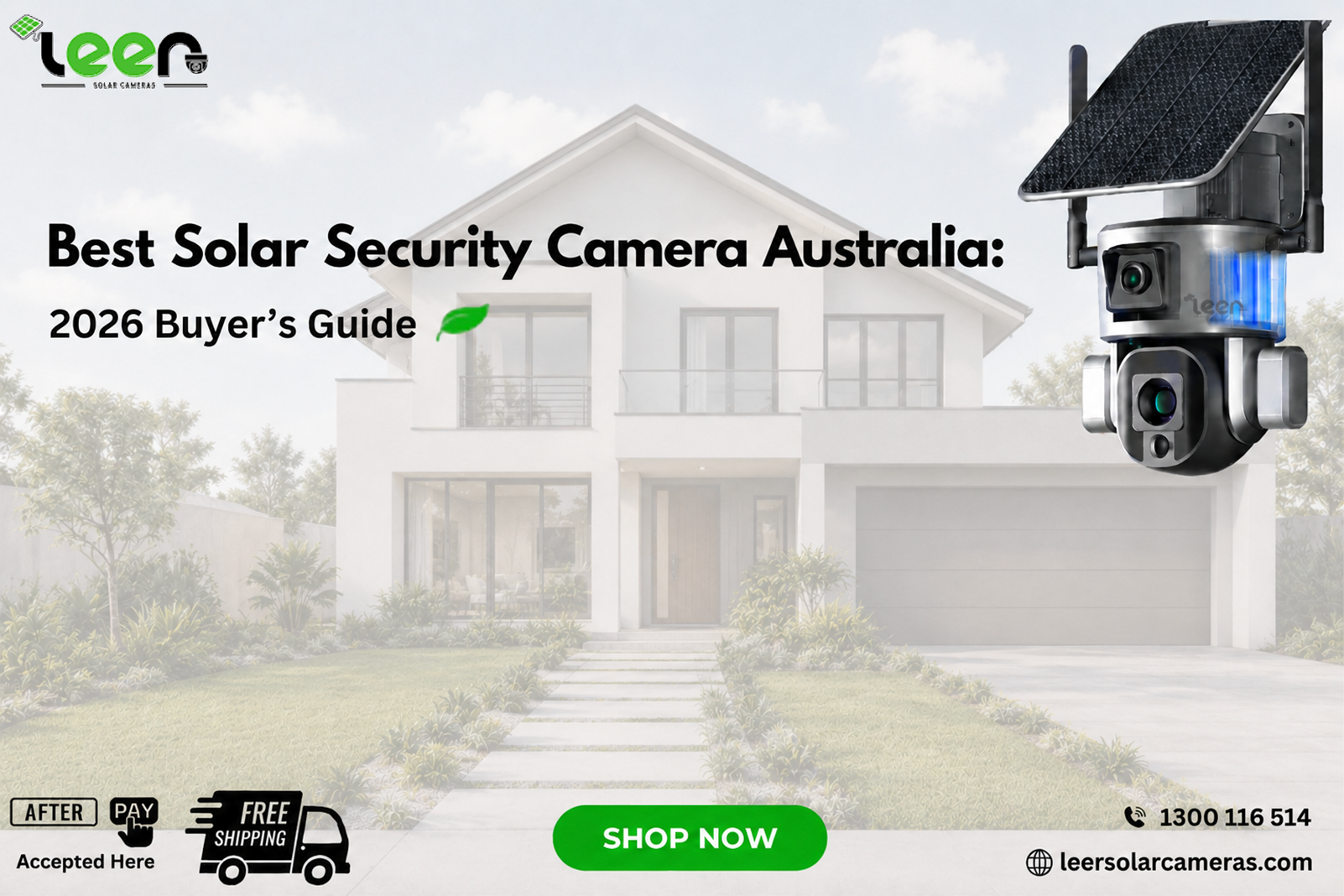
Choosing the right solar security camera in Australia comes down to three things: how much sun your property gets, whether you have WiFi where you need the camera, and how far you need to see clearly.
Get those three right and you'll have a system that runs reliably for 8–15 years with zero power bills, zero cabling, and zero monthly fees. Get them wrong and you'll be returning a $300 camera within a month.
This guide cuts through the marketing noise. We'll walk you through what actually matters for Australian conditions, compare the four solar cameras in our range side-by-side, and answer the questions every buyer asks before clicking purchase.
Why Solar Security Cameras Make Sense in Australia
A few realities make Australia almost perfectly suited to solar surveillance.
We get serious peak sun hours nearly everywhere. Even Hobart averages over four hours of direct sun per day across the year, while Brisbane, Perth and Darwin comfortably clear six. That's more than enough to keep a quality solar camera topped up year-round.
Then there's the property factor. Many Australian homes sit on larger blocks than their European or Asian counterparts, and rural properties, sheds, gates, dam pumps and outbuildings often sit hundreds of metres from the nearest power point. Running cable to those locations is expensive — sometimes impossible. A self-contained solar camera solves the problem in an afternoon.
The ongoing savings stack up too. A typical wired CCTV system draws power 24 hours a day. Across four cameras, that's $40–$80 per year in electricity alone. Multiply that by the 8–15 year lifespan of a good solar camera and the savings are substantial, especially given today's energy prices.
What Separates the Best Solar Cameras From the Rest
Not all solar cameras are created equal, and a surprising number of cheap imports fail their first Australian summer. Here's what to look for when comparing models.
Connectivity: WiFi vs 4G
This is your first decision. WiFi solar cameras are simpler and slightly cheaper, but they need a strong signal at the install location — which rules out most rural and large-property use cases. 4G solar cameras use a SIM card to connect over Telstra, Optus or Vodafone networks, making them genuinely off-grid devices.
There's a security angle too. Thieves have been known to use WiFi jammers to block camera signals before a break-in. With a 4G camera, they can't do that.
Solar Panel Wattage and Battery Capacity
Anything under 5W of solar input is asking for trouble through a wet winter. Look for cameras paired with at least a 5W panel for compact models, and ideally a separate (rather than integrated) panel so you can angle it toward the sun independently of the camera. For long-range or PTZ cameras with motors that draw more power, look for 60W+ panels and 40Ah batteries.
Weather Rating
Australia throws everything at outdoor electronics: 45°C heat, driving rain, salt spray near the coast, and red dust inland. IP66 is what you want — it handles powerful water jets and complete dust ingress protection, which is what coastal and cyclone-prone regions demand.
Resolution and Night Vision
2K (4MP) is now the sweet spot for most homes, while 4K (8MP) is genuinely useful when you need long-range identification — like reading a numberplate at the gate. For night vision, look for colour night vision with a built-in spotlight plus traditional infrared, giving you flexibility based on conditions.
AI Detection
Smart human and vehicle detection isn't a gimmick anymore. It dramatically reduces false alerts from kangaroos, possums, swaying gum branches and passing clouds — which means you actually pay attention when your phone buzzes.
The Best Solar Security Cameras in Our Range
Every Leer Solar Camera is built specifically for Australian conditions and backed by a 2-year warranty plus a 100% money-back guarantee. Here's how our four core models compare.
|
Model |
Resolution |
Zoom |
Connectivity |
Best For |
Price From |
|
SolarLite |
2MP |
4x digital |
WiFi or 4G |
Single entry point monitoring, sheds, side gates |
Entry-level |
|
Guardian S10 |
4MP |
3x digital |
WiFi or 4G |
Homes, farms, worksites, all-rounder |
$319 |
|
ArmorEye 2.0 |
8MP / 4K |
20x optical |
WiFi or 4G |
Long-range identification, larger properties |
$799 |
|
Horizon |
8MP |
36x optical |
WiFi |
Massive properties, extreme long-range surveillance |
Premium tier |
SolarLite — The Smart Entry Point
The SolarLite is the easiest way to add solar protection to a single area: a side gate, a shed door, a carport, a granny flat. Available in both WiFi and 4G versions, it gives you 2MP video with 4x digital zoom in a compact, weatherproof housing.
It's the model we recommend when you want to test solar camera technology without a major investment, or when you need to cover a specific spot rather than monitor a wide area.
Guardian S10 — The All-Rounder
The Guardian S10 is the model most Australian homeowners and small property managers should be looking at. It delivers 4MP (2592 × 1520) resolution with full 355° pan and 100° tilt, so you can sweep across an entire driveway or paddock from your phone.
What sets it apart for Australian conditions is the combination of features at the price point. You get PIR motion sensing combined with AI human-shape detection to cut false alarms, infrared plus colour night vision with three modes (IR, Colour, Smart), two-way audio, and an IP66 weather rating that handles serious weather.
Available in both WiFi and 4G versions starting from $319, it ships with everything you need: rechargeable battery, solar panel, 3m connection cable, and the option to add a 128GB microSD card for local storage. The Guardian S10 is genuinely a set-and-forget security upgrade — mount it, connect it through the app, and it just works.
ArmorEye 2.0 — When You Need to See Detail at Distance
When 4MP isn't enough, the ArmorEye 2.0 steps up to 8MP 4K resolution with 20x optical zoom — the kind of clarity that lets you identify faces and read numberplates from across a large property. It includes intelligent human tracking, two-way audio, and is available in both WiFi and 4G models.
This is the model to choose for larger blocks, rural homes, or commercial sites where you need genuine identification capability rather than just movement detection. With pricing starting at $799 (currently 33% off the $1,199 RRP), it's exceptional value for what you're getting.
Horizon — Maximum Power for Maximum Properties
The Horizon is our top-tier solar camera, designed for the largest properties and most demanding surveillance needs. With 8MP resolution, an extraordinary 36x optical zoom, a 60W solar panel and a 40Ah battery, it delivers professional-grade long-range surveillance that runs indefinitely on Australian sunshine.
Full 360° PTZ control, AI motion detection, two-way audio and a heavy-duty white housing make it the camera of choice for farms, vineyards, large rural homes and commercial properties where wide coverage and identification at distance both matter.
Solar Camera Comparison Australia: Choosing the Right Model
Quick guide to matching the camera to your situation:
If you have suburban WiFi reaching where you need the camera, choose the WiFi version of any model. It's slightly cheaper and there's no monthly SIM cost.
If you have a rural property, building site, holiday home, or anywhere WiFi doesn't reach, choose a 4G model. You'll need a data SIM (any provider works — Telstra typically has the best rural coverage), and 1GB per month minimum is usually enough.
If you're monitoring one specific spot, the SolarLite or Guardian S10 will do the job perfectly.
If you need to cover a whole property and identify people or vehicles at distance, step up to the ArmorEye 2.0 or Horizon.
For maximum range and uninterrupted operation through any weather, the Horizon's 60W panel and 40Ah battery are unmatched.
Installation: What You Actually Need to Know
The good news is that solar cameras are genuinely DIY-friendly. Most installs take under an hour and need nothing more than a drill, a ladder, and your phone.
The most important decision is panel placement. In Australia, panels should face north (the opposite of the Northern Hemisphere advice you'll see online) and tilt at roughly your latitude angle — about 30° in Sydney and Perth, closer to 40° in Melbourne and Hobart. Avoid morning shade from trees or fences, since the camera does most of its charging in the early hours.
Mount the camera itself 2.5 to 3 metres off the ground. Lower than that and it's easy to tamper with; higher and you lose facial detail.
For 4G models, test mobile reception at the exact mounting location before you drill. A bar or two of signal on your phone is usually enough, but it's worth checking with the SIM you'll actually use.
For WiFi models, your network needs to support 2.4GHz, have a ping under 100ms, and an upload speed of at least 1 Mbps where the camera will be installed.
FAQ: Your Solar Security Camera Questions Answered
Do solar security cameras work in winter or during cloudy weather?
Yes, Quality solar cameras like ours are designed to bank enough charge during sunny days to keep running through extended overcast periods. Even Tasmanian winters are no problem when the camera is sized correctly — and our larger models like the Horizon can run for weeks without sun thanks to the 40Ah battery.
Do I need WiFi to use a solar security camera?
Only for WiFi models. Our 4G solar cameras use a SIM card to connect directly to mobile networks, which means they work anywhere you can make a phone call — including remote farms, holiday shacks and construction sites with no internet at all.
How long does a solar powered security camera last?
A high-quality solar CCTV camera lasts 8–15 years depending on build and maintenance. The solar panel itself usually lasts over a decade, while the rechargeable battery may need replacement every 3–5 years. Regular cleaning of the panel and correct positioning in sunlight extends its lifespan significantly.
Does a SIM card come included with 4G models?
No, you'll need to choose a provider with good coverage in your area. Any Australian carrier works (Telstra, Optus, Vodafone). You only need 1GB per month minimum to operate the unit, so prepaid data-only SIMs are usually the cheapest option.
Are there any monthly fees for the app or cloud storage?
The app is completely free to download and use. Cloud storage is optional and has a small subscription fee, but most customers just use a 128GB microSD card for local recording — no ongoing costs.
Can I share access with family or staff?
Yes, Through the free app, you can share device access with as many people as you like. Up to three users can view the live feed simultaneously, and you control exactly what permissions each person gets — viewing, intercom, playback, and so on.
Are Leer Solar Cameras covered by warranty?
Every camera in our range comes with a 2-year warranty plus a 100% money-back guarantee if you're not satisfied. We're Australian owned and operated based in Yatala, QLD, with all orders dispatched within 24 hours and free shipping Australia-wide.
Do these cameras work with Telstra, Optus and Vodafone?
Yes, our 4G models support multiple regions and work with any Australian carrier. Telstra typically offers the best coverage in remote and rural areas, but Optus and Vodafone are perfectly fine for suburban and most regional installations.
Find Your Best Solar Camera Australia Has to Offer Today
The best solar camera Australia has available depends entirely on your property, but the search doesn't need to be complicated. The Guardian S10 covers most homeowners. The SolarLite is perfect for a single entry point. The ArmorEye 2.0 brings 4K detail when distance matters. And the Horizon delivers professional-grade surveillance for the most demanding properties.
Whatever you choose, you're getting hardware built for Australian conditions, backed by a local team in Queensland, with a 2-year warranty, free Australia-wide shipping, and a 100% money-back guarantee.