
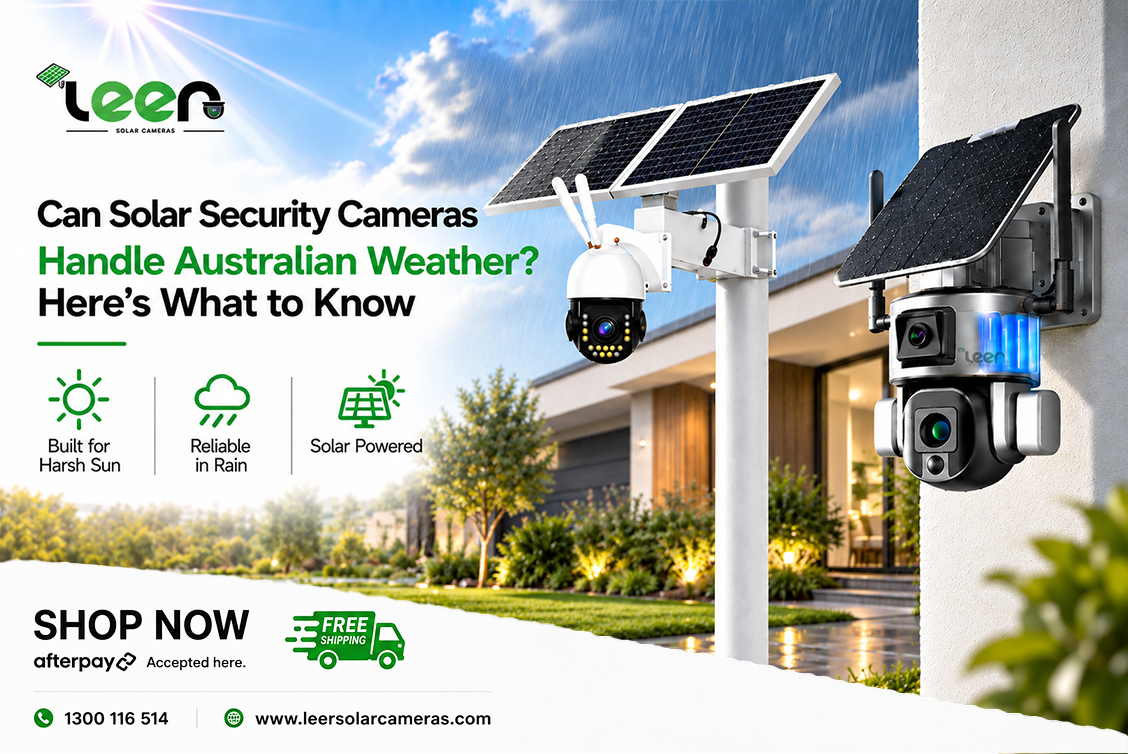
Australia experiences a wide range of weather conditions throughout the year, from intense summer heat and heavy rain to cloudy days and strong winds. For outdoor security systems, these conditions can make reliability an important consideration.
A solar security camera offers an alternative to traditional wired security systems by combining solar power, rechargeable battery technology, and wireless connectivity. But how well can solar cameras handle Australian weather, and what should you consider before installing one?
What Makes a Solar Security Camera Suitable for Australian Weather?
A camera installed outdoors needs to handle changing environmental conditions while continuing to provide reliable monitoring. This is why weather protection, battery capacity, solar charging, and installation location all matter when choosing solar security cameras.
For Australian properties, look for a camera designed specifically for outdoor use and with an appropriate weather-resistance rating.
The right setup can help you monitor areas such as:
-
Homes and driveways
-
Farms and rural properties
-
Construction sites
-
Gates and entrances
-
Sheds and storage areas
-
Remote properties
Can Solar Cameras Work in Hot Australian Weather?
Yes, solar cameras are designed to operate outdoors, including in warm and sunny conditions. However, the installation location still matters.
A solar panel needs good exposure to sunlight to recharge the camera's battery. Avoid placing the panel where trees, buildings, roofs, or other objects can block sunlight for long periods.
At the same time, the camera should be positioned to provide a clear view of the area you want to monitor.
This makes installation an important part of getting reliable performance from a solar camera.
What Happens During Rain or Cloudy Weather?
Cloudy weather does not automatically mean a solar security camera will stop working.
The solar panel charges the rechargeable battery when sunlight is available, while the stored battery power can operate the camera when solar charging is reduced.
However, charging performance can vary depending on sunlight exposure, weather conditions, battery capacity, and how actively the camera is being used.
For this reason, battery capacity is an important factor when choosing solar cameras for outdoor monitoring.
Are Solar Security Cameras Weather Resistant?
If you are installing a security camera outdoors, weather resistance should be one of the features you check before purchasing.
An appropriate IP rating can help protect the camera against environmental exposure such as dust and water.
Leer Solar Cameras offers outdoor solar security camera models designed for different property and monitoring requirements. For example, the ArmorEye 2.0 and Horizon Solar Camera are designed for outdoor use and offer IP66 protection.
This type of protection can be particularly useful for cameras installed on exposed areas of a property.
However, weather resistance is only one part of the installation. Correct mounting and positioning are also important for long-term performance.
Can a 4G Solar Security Camera Work Without Wi-Fi?
Yes. A 4G solar security camera can be useful for locations where Wi-Fi is unavailable or difficult to provide.
Instead of relying on a local Wi-Fi connection, compatible 4G cameras use a SIM card and mobile network connection for remote access and monitoring.
This can make them useful for:
-
Farms
-
Rural properties
-
Construction sites
-
Remote gates
-
Sheds
-
Off-grid locations
Solar power and 4G connectivity solve two different problems. The solar panel helps provide power, while 4G provides connectivity where Wi-Fi may not be practical.
What Should You Consider Before Installing a Solar Camera?
Australian weather is only one part of choosing the right security system. You should also consider where the camera will be installed and what you need it to monitor.
1. Solar Exposure
Choose a location where the solar panel can receive suitable sunlight throughout the day.
2. Weather Protection
Check the camera's weather-resistance rating before installing it in an exposed outdoor location.
3. Battery Capacity
Consider battery capacity based on your camera usage and local sunlight conditions.
4. Connectivity
Decide whether Wi-Fi or a 4G solar security camera is more suitable for your property.
5. Monitoring Distance
For large properties, consider the camera's resolution, zoom capability, and viewing range.
Which Solar Security Camera Is Right for Australian Properties?
Different properties require different levels of monitoring.
ArmorEye 2.0
The ArmorEye 2.0 is designed for detailed outdoor monitoring and combines high-resolution imaging with a 4MP dual-camera setup with 20X zoom. It can be used for applications such as homes, farms, driveways, gates, construction sites, and remote properties.
Its solar-powered design also provides flexibility where traditional power connections may be difficult.
Horizon Solar Camera
The Horizon Solar Camera is built for larger outdoor areas, featuring 8MP 4K imaging, 36X optical zoom, an 80W solar panel, 40Ah battery, up to 100m range, and IP66 protection for reliable outdoor surveillance.
It can be suitable for applications such as farms, acreage, large properties, gates, and business perimeters where monitoring a wider area is required.
The choice between different solar powered security camera models should depend on your property's size, viewing distance, connectivity requirements, and installation location.
Are Solar CCTV Cameras Suitable for Australian Properties?
A solar CCTV camera can be a useful option when running traditional power cables to an outdoor location is difficult or impractical.
Instead of positioning a camera around an existing power outlet, solar-powered systems provide greater flexibility for selecting an appropriate installation point.
For properties with reliable Wi-Fi, a Wi-Fi solar camera may be suitable. For remote locations without suitable Wi-Fi, a 4G model can provide another connectivity option.
This flexibility makes solar security systems suitable for a range of Australian environments.
How to Get Better Performance From Your Solar Security Camera
A few simple installation considerations can help you get more from your system:
-
Install the solar panel where it receives good sunlight.
-
Keep the panel clear of leaves, dirt, and other obstructions.
-
Position the camera to cover the most important areas.
-
Check your Wi-Fi or 4G coverage before installation.
-
Choose the battery capacity according to your monitoring requirements.
-
Select the right viewing range for the size of your property.
-
Check the camera's weather-resistance rating for outdoor installation.
Final Thoughts
So, can solar security cameras handle Australian weather?
They can be a suitable option for Australian outdoor security when the camera is designed for outdoor conditions and installed correctly. Weather protection, solar exposure, battery capacity, connectivity, and viewing requirements all play a role in the overall setup.
Whether you need security for a home, farm, construction site, business, or remote property, the right solar security camera can provide flexible monitoring without depending entirely on traditional power connections.
Before choosing a camera, consider your property's environment, the area you need to monitor, available connectivity, and the level of detail you require. This will help you choose a solar camera that matches your specific security needs.